Climate
VPD Calculator: How to Read the Number and Use It in Practice
Use this guide when you need a VPD value you can actually work with. It covers the calculation, the useful target ranges, and the fastest climate levers to adjust.
SteerMind AI can diagnose this exact issue from a symptom description or leaf photo — and give you a concrete action plan in seconds.
What Is VPD?
Vapor Pressure Deficit (VPD) describes the difference between the saturation vapor pressure at the leaf surface and the actual vapor pressure of the surrounding air. It is the key climate parameter that governs a plant's transpiration rate.
While relative humidity (RH) only indicates how much moisture the air holds relative to its current temperature, VPD provides an absolute measure of the driving force behind water loss through the stomata. A higher VPD means the air has greater capacity to absorb moisture — the plant transpires more.
Why VPD Matters
- Transpiration drives nutrient transport: Water and nutrient uptake through the roots is directly powered by transpiration pull. Without adequate VPD, xylem flow stagnates.
- Stomatal regulation: Plants open and close their stomata in response to VPD. If the deficit is too large, stomata close to prevent desiccation — reducing CO2 uptake and photosynthesis.
- Pathogen prevention: A well-tuned VPD keeps leaf surfaces dry and reduces the risk of Botrytis, powdery mildew, and other moisture-dependent pathogens.
- Quality control: During late flower, VPD significantly influences resin and terpene production, as terpenes evaporate from the leaf surface.
Core formula: VPD = SVP(leaf temperature) - AVP(air)
SVP = Saturation Vapor Pressure, AVP = Actual Vapor Pressure
How to Calculate VPD — Step by Step
VPD calculation is based on the Magnus formula, which describes saturation vapor pressure as a function of temperature. Here is the complete calculation:
-
Step 1: Saturation Vapor Pressure (SVP) at Leaf Temperature
Calculate the SVP using the Magnus formula:
SVP(T) = 0.6108 × exp((17.27 × T) / (T + 237.3))Where T is the leaf temperature in °C. Example at 26°C leaf temperature:
SVP(26) = 0.6108 × exp((17.27 × 26) / (26 + 237.3)) = 3.36 kPa -
Step 2: Calculate Actual Vapor Pressure (AVP) of the Air
The AVP is derived from the SVP at air temperature multiplied by the relative humidity:
AVP = SVP(T_air) × (RH / 100)Example at 24°C air temperature and 60% RH:
SVP(24) = 2.98 kPa → AVP = 2.98 × 0.60 = 1.79 kPa -
Step 3: Determine VPD
The difference yields the Vapor Pressure Deficit:
VPD = SVP(leaf) - AVP = 3.36 - 1.79 = 1.57 kPa -
Step 4: Interpret the Result
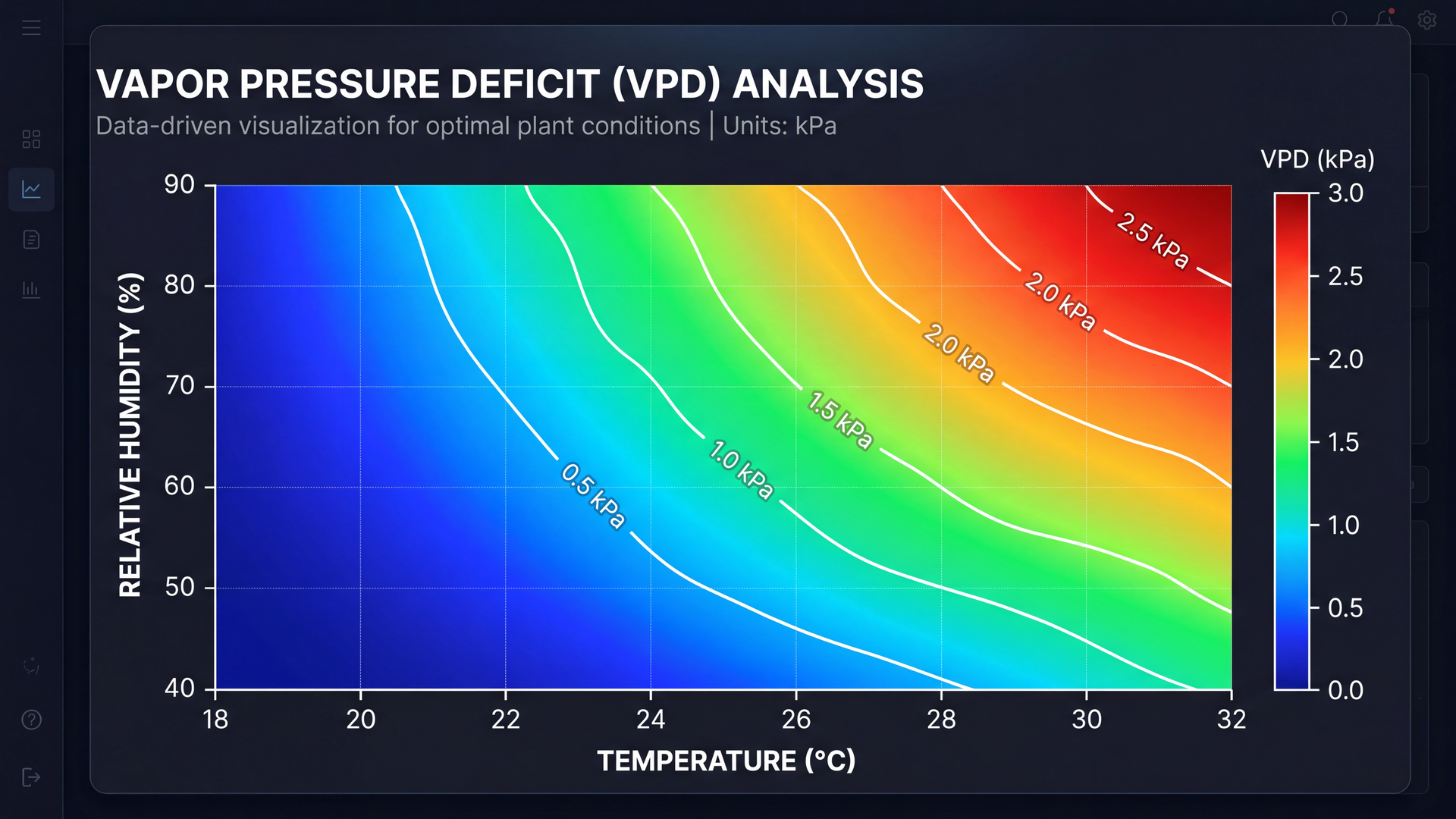
Compare the calculated VPD against the target values for your current growth stage (see chart below). In this example, 1.57 kPa would be optimal for late flower, but too high for the vegetative phase.
Pro tip: Leaf temperature differs from air temperature depending on the light source. Under HPS lamps, the leaf surface typically runs 2-3°C above air temperature; under LED, it often sits 1-2°C below. An infrared thermometer (~$20-30) is the single most valuable investment for precise VPD management.
Interactive VPD Calculator
Enter your leaf temperature, air temperature, and relative humidity to calculate your current VPD.
Calculate VPD
VPD Chart by Growth Stage
Optimal VPD ranges vary by developmental stage. Young plants with underdeveloped root systems require a lower VPD to avoid drought stress. As root mass and leaf area increase, VPD can be raised to maximize transpiration and, consequently, nutrient transport.
| Growth Stage | VPD Target Range (kPa) | Typical Conditions |
|---|---|---|
| Seedling / Clone | 0.4 – 0.8 | 24-26°C / 70-80% RH |
| Vegetative | 0.8 – 1.2 | 24-28°C / 55-70% RH |
| Early Flower | 1.0 – 1.4 | 24-27°C / 50-60% RH |
| Late Flower | 1.2 – 1.6 | 22-26°C / 40-50% RH |
Important: These values are guidelines. Genetics, growing medium, and CO2 supplementation all influence the optimal range. Under elevated CO2 (1200-1500 ppm), VPD targets can be shifted upward by approximately 0.2 kPa, since stomata do not need to open as wide at higher CO2 concentrations.
VPD Too High or Too Low
VPD Too High (> target range)
An excessive Vapor Pressure Deficit forces the plant into over-transpiration. Typical symptoms include:
- Leaf edges curling upward (taco leaves)
- Leaf tips turning brown and dry (tip burn)
- Wilting despite adequate irrigation
- Reduced stem elongation
- At extreme VPD: stomatal closure, CO2 uptake drops, photosynthesis stalls
Corrective measures for high VPD:
- Increase humidity: deploy humidifiers, increase evaporative surface area
- Lower temperature: air conditioning, increased night-time drop, throttle exhaust fans
- Reduce light intensity: dim fixtures or increase lamp-to-canopy distance (lowers leaf temperature)
- Increase irrigation frequency to compensate for elevated water demand
VPD Too Low (< target range)
A VPD that is too low means the air is nearly saturated. The plant can barely transpire:
- Nutrient transport stalls — calcium and magnesium deficiencies despite adequate feeding
- Guttation (water droplets on leaf tips and margins)
- Soft, unstable shoots with elongated internodes
- Significantly increased risk of Botrytis, powdery mildew, and Pythium
- Edema formation (water blisters on leaf surfaces)
Corrective measures for low VPD:
- Deploy dehumidifiers or increase exhaust fan capacity
- Raise temperature slightly (increases the air's moisture-holding capacity)
- Improve air circulation — oscillating fans at canopy height
- Reduce plant density to prevent microclimate pockets
Pro tip: The most critical window for Botrytis is late flower during the dark period. As temperature drops and RH rises, VPD can fall below 0.4 kPa. A night-time dehumidifier or a minimum exhaust baseline is essential here.
VPD and Climate Control
Active VPD management requires coordinated temperature, humidity, and airflow control. The following strategies help maintain VPD precisely across every growth stage.
Temperature Management
Temperature is the strongest control variable for VPD, since saturation vapor pressure rises exponentially with temperature. A difference of just 2°C can shift VPD by 0.2-0.3 kPa.
- Day/Night differential (DIF): A 4-6°C night-time drop is standard. During late flower, a negative DIF (night warmer than day) can help keep VPD more stable during the dark period.
- Ramp-up / Ramp-down: Gradual temperature transitions (30-60 min.) prevent condensation on leaf surfaces during light changes.
Humidity Management
- Humidifiers: Ultrasonic humidifiers for small rooms, evaporative units for larger spaces. Always position above canopy height, never aimed directly at plants.
- Dehumidifiers: Often more important than humidifiers during the flowering phase. Sizing guideline: at least 10-15 liters/day per 10 m2 of grow area during late flower.
- Exhaust as dehumidification: Cost-effective, but only works when outdoor air is drier than room air. Often not the case in summer.
Air Circulation
Stagnant air creates microclimates within the canopy that can deviate significantly from the measured VPD. Oscillating fans at canopy height and slight negative pressure via exhaust ensure homogeneous conditions.
Pro tip: Place VPD sensors at canopy height, not on the wall or near the ceiling. Readings can differ by 0.3-0.5 kPa depending on position — especially in rooms with passive cooling.
VPD Control with Climate Controllers
Modern climate controllers (e.g., TrolMaster, Pulse, Niwa) can use VPD directly as the control variable. Instead of managing temperature and RH separately, the controller regulates humidifiers, dehumidifiers, air conditioning, and exhaust based on a VPD setpoint. This is the gold standard for professional cultivation.
Note: Even with automated VPD control, sensor placement remains critical. Calibrate temperature and humidity sensors regularly (every 3-6 months) and use at least two measurement points per room for redundancy.
Quick answers
What is a good VPD value for cannabis?
The optimal VPD depends on the growth stage: seedling/clone 0.4-0.8 kPa, vegetative 0.8-1.2 kPa, early flower 1.0-1.4 kPa, and late flower 1.2-1.6 kPa. With CO2 supplementation, these values can be shifted upward by approximately 0.2 kPa.
What happens when VPD is too high?
Excessive VPD leads to over-transpiration, drought stress, leaf curling, and nutrient burn at the leaf tips. The stomata close as a defense mechanism, which reduces CO2 uptake and slows growth. Over time, both yield and quality decline.
How do I lower VPD in my grow room?
Lowering VPD means either increasing humidity (humidifiers, evaporative surfaces) or reducing temperature (air conditioning, night-time drop, throttling exhaust). Reducing light intensity also lowers leaf temperature and thereby VPD.
Do I need to measure leaf temperature, or is air temperature sufficient?
For accurate VPD calculation, leaf temperature is essential. As a rule of thumb: under HPS, the leaf surface runs about 2-3°C above air temperature; under LED, about 1-2°C below. An infrared thermometer provides precise readings and costs only $20-30.
Why is VPD more important than relative humidity alone?
Relative humidity (RH) only describes the moisture content of the air relative to its temperature. VPD combines temperature and humidity into a single value that directly reflects the plant's transpiration rate. For example: 60% RH at 20°C and 60% RH at 30°C yield completely different VPD values — and therefore very different physiological demands on the plant.