Light
PPFD, DLI, Stretch, and Internodes: Using Light to Shape Plant Structure
Light is not just about yield. It also sets plant shape, internode spacing, and the pace of stretch, which is why PPFD and DLI need to be read in context.
SteerMind AI can diagnose this exact issue from a symptom description or leaf photo — and give you a concrete action plan in seconds.
What Is PPFD?
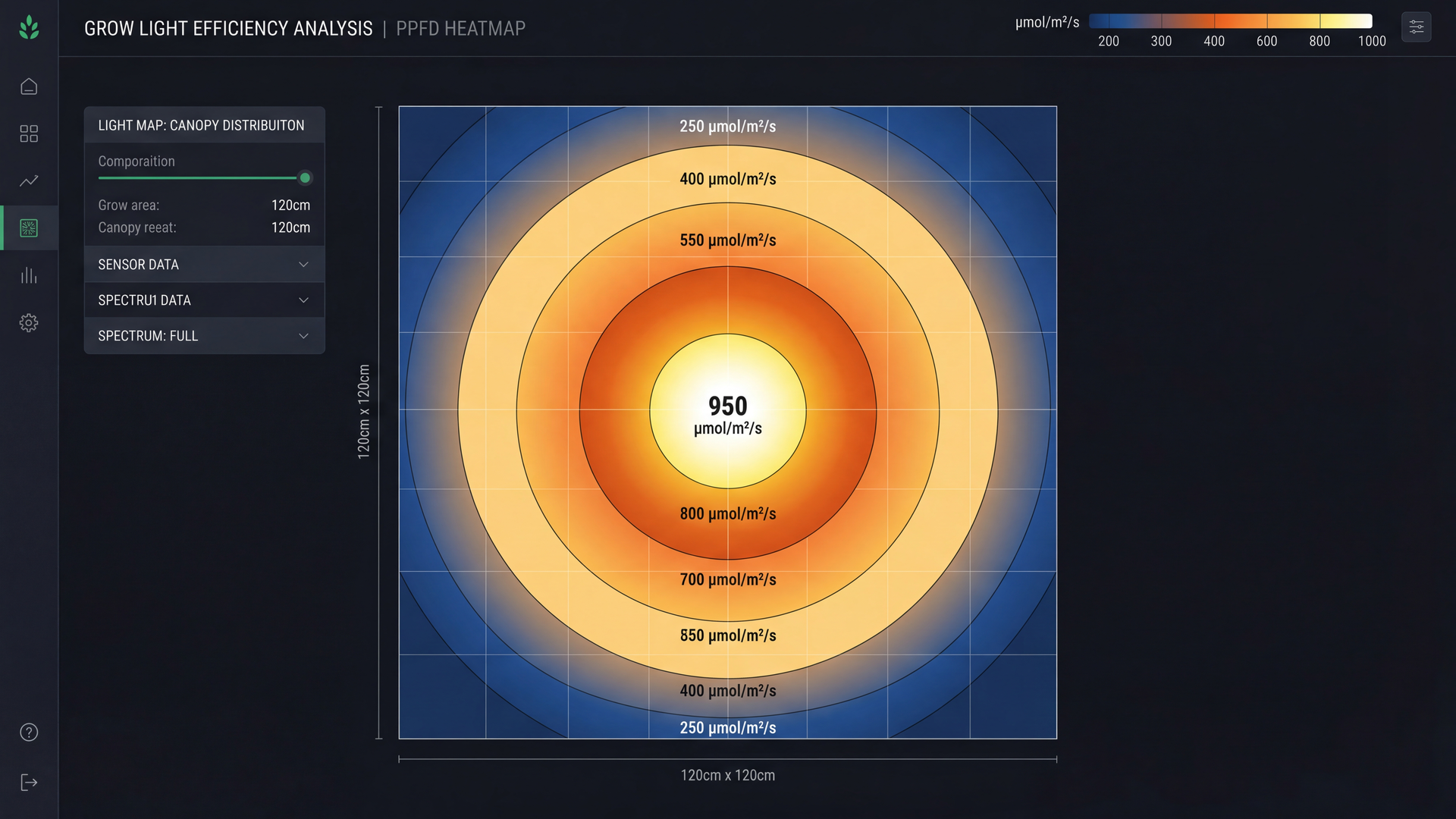
PPFD (Photosynthetic Photon Flux Density) measures the number of photosynthetically active photons in the 400-700 nm wavelength range that strike one square meter per second. The unit is µmol/m²/s (micromoles per square meter per second).
Why PPFD Instead of Lux?
Lux measures brightness from the perspective of the human eye and disproportionately weights green light. Plants, however, utilize the entire PAR spectrum (400-700 nm), with absorption peaks in the red and blue ranges. A high-pressure sodium lamp (HPS) and an LED can share the same lux reading yet deliver vastly different PPFD values.
How to Measure PPFD
- PAR Meter / Quantum Sensor: The gold standard. Devices such as the Apogee MQ-500 directly measure the photon flux within the PAR range.
- Manufacturer PPFD Maps: Reputable LED manufacturers provide PPFD maps for defined hanging heights. Use these as your starting point.
- Smartphone Apps: Suitable only as a rough guide — smartphone sensors are not calibrated for PAR measurement.
PPFD Targets by Growth Phase
| Phase | PPFD (µmol/m²/s) | Notes |
|---|---|---|
| Seedling / Clone | 100 – 300 | Excessive light burns young leaves. Increase gradually. |
| Vegetative | 400 – 600 | Sufficient for vigorous growth without light stress |
| Early Flower | 600 – 800 | Stretch phase: higher light reduces elongation |
| Full Flower | 800 – 1200 | Maximum without CO2 supplementation: ~800 |
| Full Flower + CO2 | 1000 – 1500 | With 1000-1500 ppm CO2. Beyond 1500 PPFD, marginal returns diminish. |
What Is DLI?
DLI (Daily Light Integral) is the total amount of photosynthetically active photons a plant receives in a single day. The unit is mol/m²/day.
DLI Formula
Example: 600 µmol/m²/s × 18 h × 3600 = 38,880,000 µmol/m²/d = 38.9 mol/m²/day
Same PPFD at 12 h of light: 600 × 12 × 3600 / 1,000,000 = 25.9 mol/m²/day
DLI is more informative than PPFD alone because it accounts for photoperiod length. A lower PPFD over a longer period can yield the same DLI as a higher PPFD over a shorter period — but the plant responds differently to each scenario.
DLI Targets
| Phase | DLI (mol/m²/day) | Typical PPFD × Hours |
|---|---|---|
| Seedling | 8 – 15 | 150 × 18 h = 9.7 or 200 × 18 h = 13.0 |
| Vegetative | 20 – 35 | 400 × 18 h = 25.9 or 550 × 18 h = 35.6 |
| Flower | 35 – 50 | 800 × 12 h = 34.6 or 1100 × 12 h = 47.5 |
| Flower + CO2 | 45 – 65 | 1200 × 12 h = 51.8 or 1500 × 12 h = 64.8 |
Stretch and Internode Spacing
Stretch refers to the rapid vertical elongation during the first 2-3 weeks after switching to the flower light cycle (12/12). Most cultivars double or even triple their height during this phase. Internode spacing — the distance between two leaf attachment points along the stem — is a direct indicator of elongation.
Why Stretch Control Matters
- Even Canopy Height: Compact plants with a uniform canopy utilize light more efficiently.
- Flower Density: Tighter internodes mean more flower sites per unit of stem length, increasing yield.
- Air Circulation: However, excessively tight internodes can restrict airflow within the canopy and raise the risk of mold.
- Space Utilization: Uncontrolled stretch can cause plants to grow too close to the light source.
Controlling Stretch Through Light and Climate
1. Increase Light Intensity
Higher PPFD during the stretch phase (weeks 1-3 of flower) signals the plant that ample light is available, making elongation unnecessary. Raise PPFD to 700-900 µmol/m²/s immediately after the flip.
2. DIF Strategy (Temperature Differential)
DIF = Day temperature − Night temperature. A large positive DIF (warm day, cool night) reduces stretch. Target values:
- Reduce stretch: DIF of +8 to +12 °C (e.g., day 26 °C, night 16 °C)
- Promote stretch: DIF near 0 or negative (equal temperatures or cooler day)
3. Light Spectrum
- Far-Red (700-780 nm): A high far-red component promotes stretch (shade avoidance response). Fixtures with significant far-red output can amplify elongation.
- Blue Light (400-500 nm): A higher proportion of blue light encourages compact growth and shorter internodes.
- Red Light (600-700 nm): Promotes photosynthesis and flower development, with a moderate influence on stretch.
4. Generative Crop Steering
Stronger dry-back cycles and increased EC during the stretch phase amplify the generative signal and reduce vegetative elongation. The combination of high PPFD, strong DIF, and generative substrate steering is the most effective form of stretch control.
Light and Other Parameters: The Interplay
Light intensity never stands alone. Higher PPFD requires adjustments to:
- CO2: Above 800 PPFD, CO2 becomes the limiting factor. Without supplementation, additional light beyond this level yields little extra growth and can even cause stress.
- VPD: Higher PPFD drives transpiration. VPD must be adjusted accordingly — typically slightly higher (1.0-1.4 kPa) to match the increased transpiration rate.
- Temperature: More light generates more heat at the leaf surface. Ensure leaf surface temperature does not exceed 30 °C.
- Nutrients: A higher rate of photosynthesis means greater nutrient uptake. EC may need to be increased.
- Irrigation: More light = more transpiration = faster substrate drying. Adjust irrigation frequency accordingly.
Internode gaps longer than 3–4 cm in veg signal insufficient DLI. Check: (1) Is PPFD below 400 µmol/m²/s? → raise light or increase power; (2) Is light schedule under 16h? → extend to 18h; (3) Is temperature above 28°C? → heat also causes stretching. Optimal internodal spacing: 2–3 cm in veg, 1–2 cm in early flower (before the stretch).
| Internode Gap | Likely Cause | Action |
|---|---|---|
| <2 cm | Good — dense growth | Maintain current PPFD and DLI |
| 2–4 cm | Acceptable in veg | Monitor; increase PPFD if growth slows |
| 4–7 cm | Mild light deficiency | Increase PPFD by 100–150 µmol/m²/s |
| >7 cm | Severe etiolation | Major light increase needed; check for heat stress too |
Frequently Asked Questions
What is the difference between PPFD and lux?
Lux measures brightness as perceived by the human eye and weights green light more heavily. PPFD measures the number of photosynthetically active photons (400-700 nm) per square meter per second and is the relevant metric for plants. Because the ratio depends on the light spectrum, there is no universal conversion factor.
How do I calculate DLI?
DLI = PPFD × photoperiod in hours × 3600 / 1,000,000. Example: 600 µmol/m²/s × 18 h × 3600 = 38,880,000 / 1,000,000 = 38.9 mol/m²/day. At 12 h of light with the same PPFD, the result is 25.9 mol/m²/day.
How do I reduce stretch during flowering?
The most effective measures: raise light intensity to 700-900 PPFD, increase the day-night temperature differential to 8-12 °C (DIF strategy), reduce far-red in the spectrum, and apply generative crop steering with a stronger dry-back. Combining all of these measures is significantly more effective than any single one alone.
Do I need CO2 supplementation at high PPFD?
Above approximately 800 µmol/m²/s, CO2 becomes the limiting factor. Without supplementation, more light beyond this point yields little extra growth and may even cause stress. With CO2 at 1000-1500 ppm, plants can effectively utilize PPFD levels up to 1500 µmol/m²/s.
What are optimal internode distances?
This depends on genetics: 2-5 cm for indica-dominant cultivars, 3-8 cm for sativa-dominant ones. Excessively tight internodes can impede air circulation and increase the risk of mold. Internode spacing is a reliable indicator of whether your light setup and climate management are working well together.