Diagnosis
Leaf Diagnosis: How to Read Yellowing, Burnt Tips, and Tacoing
Treat this as a first-pass visual guide for common leaf symptoms. It helps you narrow the likely causes before you start changing nutrients, climate, or light intensity.
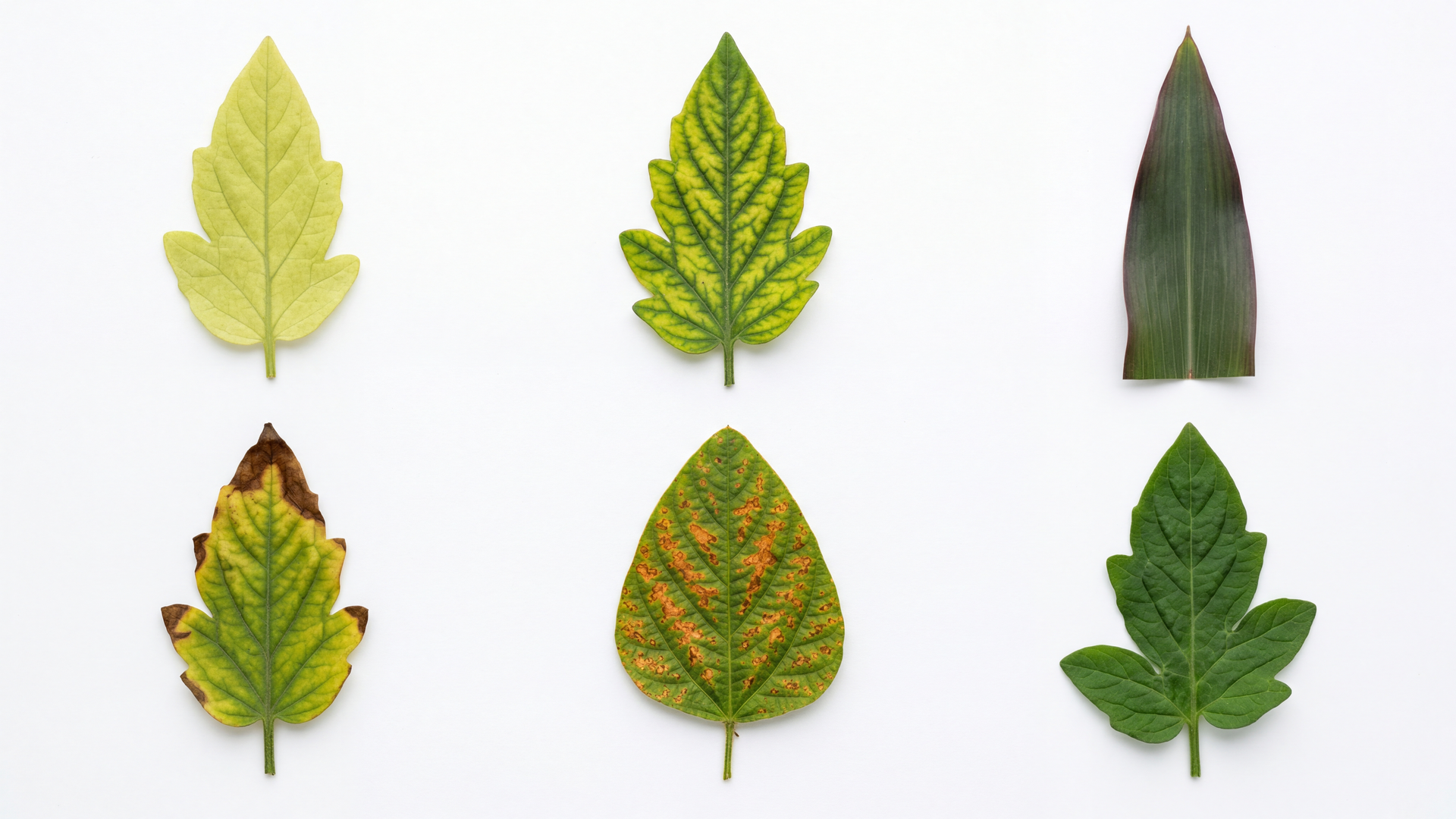
SteerMind AI can diagnose this exact issue from a symptom description or leaf photo — and give you a concrete action plan in seconds.
Systematic Leaf Diagnosis
Leaves are the most important diagnostic tool in plant cultivation. Every discoloration, deformation, or necrosis tells a story — but only when read in context. A single yellow leaf is no reason to panic. Only the combination of position, distribution pattern, and accompanying conditions yields a reliable picture.
Important: Visual symptoms alone are often ambiguous. The same yellowing can point to nitrogen deficiency, overwatering, or root problems. Without measured data (EC, pH, VPD), any diagnosis remains guesswork.
What matters in leaf diagnosis
- Position on the stem: Symptoms on lower, older leaves point to mobile nutrients (N, P, K, Mg). Symptoms on upper, young leaves suggest immobile nutrients (Ca, Fe, Mn, B) or environmental stress.
- Distribution pattern: Uniform chlorosis vs. interveinal chlorosis vs. patchy — each pattern narrows the range of possible causes.
- Symmetry: If the problem appears on one side only (e.g., only the light-exposed side), an environmental factor is likely. Uniform distribution points to systemic causes (nutrients, pH, roots).
- Speed of onset: Acute stress (light burn, heat shock) shows up within hours. Nutrient deficiencies develop over days to weeks.
- Growth stage: During flowering, plants have higher PK demands; mild yellowing of the lowest leaves is physiologically normal (nutrient remobilization).
Tip: Document symptoms with photos and simultaneously record EC, pH (input and runoff), room temperature, humidity, and light intensity. These data points are indispensable for an accurate diagnosis.
Yellowing (Chlorosis)
Chlorosis — the loss of chlorophyll — is the most common leaf symptom in cultivation. The challenge lies in differentiation: at least five different causes can look virtually identical. The following table helps with systematic narrowing down.
| Symptom | Position | Probable Cause | First Action |
|---|---|---|---|
| Uniformly yellow leaves | Lower / older leaves | Nitrogen deficiency (N) | Increase EC, check N ratio in fertilizer |
| Interveinal chlorosis (veins stay green) | Upper / young leaves | Iron deficiency (Fe) — usually caused by pH > 6.5 | Lower pH to 5.8–6.0, supplement with Fe chelate if needed |
| Interveinal chlorosis (veins stay green) | Lower / middle leaves | Magnesium deficiency (Mg) | Epsom salt 1–2 g/L as foliar spray or added to nutrient solution |
| Uniformly pale green to yellow | Entire plant | Sulfur deficiency (S) or insufficient light | Check S content in fertilizer; verify light intensity and duration |
| Patchy yellow, irregular | Various leaves without a clear pattern | pH fluctuations, root problems, overwatering | Measure runoff pH and EC, check substrate moisture, inspect roots |
Nitrogen deficiency vs. natural senescence
During late flower, plants remobilize nitrogen from the lower leaves to support bud development. Mild yellowing of the lowest leaves from week 5–6 of flowering onward is physiologically normal. It becomes problematic when the chlorosis moves upward rapidly or appears during the vegetative stage.
Iron deficiency — the pH problem
Iron deficiency is rarely an actual shortage in the fertilizer. Almost always, the cause is a substrate pH that is too high: above pH 6.5, iron becomes increasingly immobilized in the root zone. The solution is nearly always pH correction, not iron supplementation.
Common mistake: Adding iron chelate immediately when interveinal chlorosis appears on the upper leaves, without checking the pH first. If the pH is not corrected, even supplemental iron remains locked out in the substrate and ineffective.
Burnt Leaf Tips (Tip Burn)
Brown or burnt leaf tips are among the most common symptoms and are often dismissed as generic "nutrient burn." In reality, several causes come into play, each requiring a different corrective approach.
Nutrient burn (EC too high)
When the nutrient concentration in the substrate is too high, the leaf tips burn. Typical appearance: sharply defined, brown, dry tips, often on multiple leaves simultaneously. The runoff EC is significantly higher than the input EC.
- Immediate action: Flush with lower EC solution, then reduce input EC going forward
- Runoff EC as an indicator: If drain EC rises continuously, salts are accumulating in the substrate
Potassium deficiency — marginal necrosis
Potassium deficiency also starts at the tips but spreads along the entire leaf margin as marginal necrosis. The older, lower leaves are affected first (potassium is mobile). It is often accompanied by mild yellowing of the leaf blade.
Wind burn — one-sided burnt tips
Strong, direct airflow on the leaves dries out the tissue. Characteristic sign: only the leaves or leaf areas facing the fan are affected. The fix is simple — reposition the fan or reduce airflow intensity.
Light burn — bleached tips
Excessive light intensity or insufficient distance to the light source leads to bleached (whitish) tips, often surrounded by a yellow halo. Light burn typically appears on the topmost leaves closest to the light.
Tip: Light burn and nutrient burn frequently occur together. High light intensity increases the plant's water demand, and when the watering frequency stays the same, nutrient concentration in the substrate rises — compounding both stressors.
| Cause | Tip Appearance | Distribution | Accompanying Factor |
|---|---|---|---|
| Nutrient burn | Brown, dry, sharp edge | Uniform across the plant | High runoff EC |
| Potassium deficiency | Marginal necrosis, spreading | Lower leaves first | Low K ratio in fertilizer |
| Wind burn | Dry, papery | One-sided, fan-facing leaves | Strong direct airflow |
| Light burn | Bleached/whitish, yellow halo | Topmost, light-closest leaves | High PPFD, low lamp distance |
Tacoing / Leaf Curling
When cannabis leaves curl laterally and look like a taco in cross-section, the plant is signaling acute stress. The direction of the curl is a key diagnostic clue.
Heat stress — leaves curl upward
The most common cause of tacoing. Once leaf temperature reaches approximately 28–30 °C, the leaves begin to curl upward to reduce their surface area exposed to the heat source. This frequently occurs in combination with low VPD (high temperature + low humidity).
- Lower room temperature to 24–26 °C
- Increase lamp distance or dim the light
- Check VPD and adjust humidity if needed
Low VPD / high humidity
At very high humidity (> 70 % RH) or low VPD (< 0.4 kPa), the plant cannot transpire adequately. The leaves curl to reduce their stomatal surface area. This symptom is especially common in dense canopies or poorly ventilated areas.
Important: Excessively high humidity during flowering not only increases the risk of tacoing but also of Botrytis (gray mold). VPD control is doubly critical at this stage.
Light burn with tacoing
Extreme light intensity can cause tacoing and bleaching simultaneously. The leaves curl and lose color on the light-exposed areas. This is typical with LEDs at close range, especially when the plant grows into the light fixture.
Root problems — leaves droop downward
While heat and light cause leaves to curl upward, root problems can cause leaves to curl downward or hang limply. Common causes:
- Overwatering / oxygen deprivation in the root zone
- Root rot (Pythium) — roots are brown and slimy instead of white
- Substrate temperature too high (> 24 °C)
Common mistake: Tacoing is often reflexively met with "water more" because the plant looks limp. In the case of heat stress, that may be correct — but with overwatering, it makes the situation considerably worse.
Diagnostic Checklist
When leaf symptoms appear, this structured checklist helps you systematically narrow down the cause. Work through the steps in order.
- Determine symptom position: Are they on old (lower) or young (upper) leaves? Lower leaves point to mobile nutrients (N, P, K, Mg, S), upper leaves to immobile ones (Ca, Fe, Mn, B, Zn) or environmental stress.
- Analyze the pattern: Uniform chlorosis, interveinal chlorosis, spots, marginal necrosis, or curling? Each pattern narrows the list of possible causes.
- Measure EC and pH (input and runoff): A runoff EC that is too high indicates salt accumulation. A pH outside the 5.5–6.5 range locks out nutrient uptake. These readings are the single most important piece of information for diagnosis.
- Check environmental factors: Verify temperature, humidity, VPD, light intensity, and air circulation. Many symptoms that look like nutrient deficiencies actually originate from the growing environment.
- Consider the timeline: When did the symptoms first appear? What changed shortly before (fertilizer switch, lamp height adjustment, room climate)? Correlation with changes is often the best diagnostic clue.
- Inspect the roots: Healthy roots are white and firm. Brown, slimy, or foul-smelling roots indicate rot or oxygen deprivation. In container grows, carefully check the root ball.
- One change at a time: Never alter multiple parameters simultaneously. Correct the most likely factor and observe the response over 3–5 days before making the next adjustment.
Tip: Damaged leaf tissue does not recover. Judge the success of your corrective action by the new growth, not by the already affected leaves.
Quick answers
How do I tell nitrogen deficiency apart from magnesium deficiency?
Nitrogen deficiency presents as uniform yellowing of the lower, older leaves — the entire leaf turns yellow, including the veins. Magnesium deficiency, on the other hand, shows interveinal chlorosis: the leaf veins stay green while the tissue between them turns yellow. Both nutrients are mobile, so symptoms start at the bottom. The difference lies in the pattern.
What does tacoing mean in cannabis leaves?
Tacoing describes the lateral curling of leaves so that their cross-section resembles a taco. The most common cause is heat stress or excessive light intensity. The plant attempts to reduce its light-exposed leaf surface area. Less commonly, low VPD or root stress can also trigger tacoing.
Burnt leaf tips — nutrient burn or potassium deficiency?
Nutrient burn (tip burn from high EC) appears as brown, dry tips with a sharp boundary to the healthy tissue, distributed across the entire plant. Potassium deficiency also starts at the tips but spreads as marginal necrosis along the entire leaf edge, affecting the older leaves first. A look at the runoff EC settles the question: if it is high, it is nutrient burn.
Can I diagnose leaf symptoms from photos alone?
Photos provide valuable initial clues but rarely suffice for a reliable diagnosis. Many symptoms look alike (e.g., N deficiency and overwatering). For a sound diagnosis, measured data are indispensable: EC and pH (input and runoff), VPD, light intensity, substrate moisture, and information on feeding history.
Which leaf symptoms point to root problems?
Root problems often manifest diffusely: general wilting despite adequate watering, patchy yellowing without a clear pattern, downward-drooping or limp leaves, and slowed growth. When symptoms do not match a typical nutrient deficiency signature, it is worth inspecting the roots. Healthy roots are white and firm — brown, slimy roots indicate rot.